
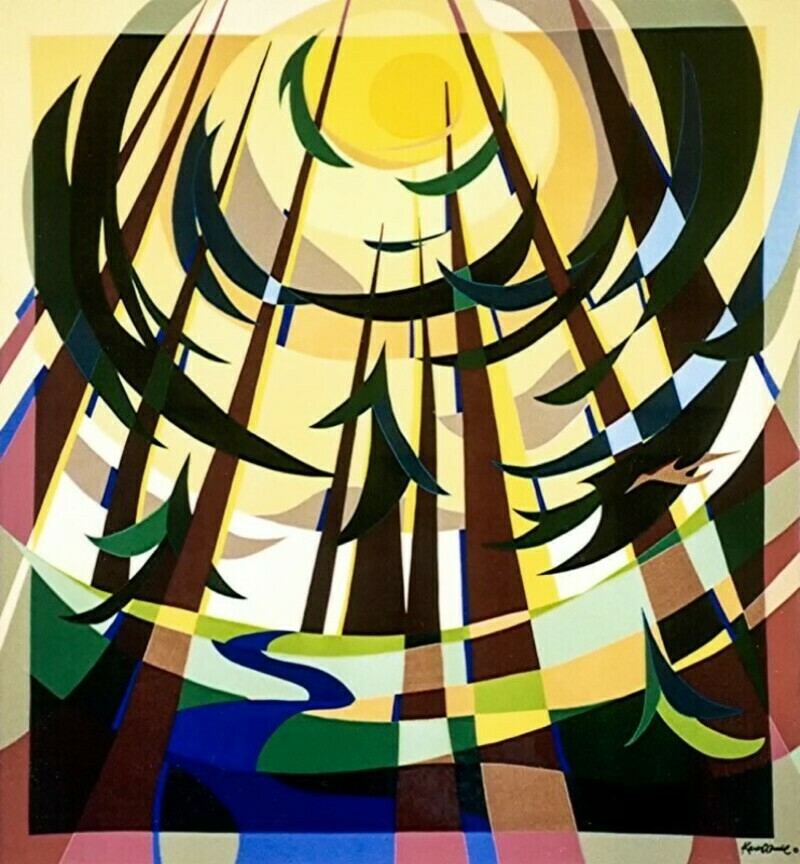
There is a saying that has become increasingly important in our world: unity is not the same as uniformity. A healthy community, unity, does not require everyone to look alike, think alike, vote alike, worship alike, or come from the same background. And true community is not created when differences disappear, uniformity. Rather, true community is created when differences are welcomed, respected, and woven together into something beautiful. Unity is not the same as uniformity. The wisdom in that saying is really what lies behind the vision we hear in our two texts.
Micah offers a dream of God's future. He sees people coming from many nations, many cultures, many languages, and many experiences. The prophet’s vision is truly one of diversity. His image is one when the people were not forced to abandon their identities. Rather in their diversity, they journey together toward God: they gather around a shared purpose; they learn God's ways; they beat their swords into plowshares and their spears into pruning hooks. Choosing cooperation over competition, understanding over suspicion, and peace over division. The prophet's vision dares to imagine a world where diversity becomes a gift rather than a threat. Diversity is celebrated and unity, not uniformity, is achieved.
Turing to Acts, we encounter a similar vision. The church described in this passage was born on Pentecost. The miracle of Pentecost was NOT that everyone suddenly spoke one language. The miracle was that everyone HEARD the gospel in their own language. The Holy Spirit did not erase differences; she honoured differences. The community that emerged was a community of diversity. Jews from every corner of the Roman Empire had gathered in Jerusalem. They brought different customs, accents, experiences, and perspectives. Yet Luke (the writer of Acts) tells us they devoted themselves to fellowship, prayer, learning, generosity, and shared life. Again, diversity is embraced.
This is God's vision for community. And it is also a vision that has shaped Northwood for many years. When we look around this congregation, we see people from different generations, different economic backgrounds, different educational experiences, different political perspectives, different family structures, and different life journeys. What makes us a church is NOT that we are all the same. What makes us a church is that we chose to walk together. What I LOVE about church (and other faith communities) is that we are one of the few institutions where such diversity is still found!
That commitment becomes even more significant when we consider the community around us. Census data tells us that Fleetwood is one of the most diverse neighbourhoods in all of British Columbia. Approximately 38 percent of Fleetwood are South Asian, around 10 percent Chinese, about 9 percent Filipino, and roughly 38 percent European descent. Fleetwood is also home to many newcomers to Canada, bringing languages, traditions, and experiences from every part of the globe.
If Micah were standing on a street corner in Fleetwood today, he might see a glimpse of his vision unfolding. He would hear Punjabi, English, Mandarin, Tagalog, Korean, and many other languages. He would see neighbours whose families originated in India, China, the Philippines, Europe, Africa, the Middle East, and beyond. Fleetwood reminds us that diversity is not an abstract concept. It is our neighbourhood. It is the reality in which God has called Northwood to minister. The question for the church is how we will respond. Do we retreat into what is familiar? Do we build walls around ourselves? Do we cling to sameness? Or do we embrace God's vision of community? At Northwood, we have intentionally chosen the latter. We don’t always get it ‘right’. But I see us trying! We embrace ALL who attend! We try to sing new music. We try to be more inclusive. We embrace this vision.
One of the most visible reminders of that commitment hangs right above our heads. Throughout the lobby ceiling is the word ‘Welcome’ painted in the many different languages in the city. Each one carries the same message: "Welcome." Those signs are much more than decoration. They are theology. They proclaim that God's love is larger than any one culture. They proclaim that every language matters and every person bears the image of God. Before anyone understands our customs, before they learn our traditions, before they feel at home, we begin by saying “welcome”.
Another way that Northwood has sought to live out this hospitality is through our commitment to being a welcoming congregation for members of the 2SLGBTQIA+ community. And when I think about this expression of welcome, I think it is yet another expression of theology. It has been about affirming that every person is a beloved child of God. It is not about ‘fixing’ someone so they can be loved. It has been about creating a community where individuals do not need to hide who they are in order to encounter God's love and extending the same welcome that Jesus extended throughout his ministry.
The reality we have discovered is that diversity is not always easy. Sometimes we romanticize the early church. We read about believers sharing possessions, breaking bread together, and enjoying one another's company, and it sounds idyllic. Yet if we were to continue reading through Acts, we would discover disagreements, misunderstandings, tensions, and conflicts. Why? Because diverse communities are complicated. People bring different perspectives, experiences, expectations, and priorities. Yet the early church community, and the present day community, remain committed to that diversity. And what the early church discovered (and what we are also discovering) was truly remarkable. We discovered that unity does not depend upon agreement about everything. Their unity depended upon a shared commitment to Christ. The same is true for us. Northwood's strength has never been that we all think alike. Our strength has been our willingness to remain at the table together: to listen, to learn, to serve, to pray, to worship, and to love.
Micah's vision concludes with one of the most beautiful images in all of Scripture: "Everyone shall sit under their own vine and under their own fig tree, and no one shall make them afraid." Notice that everyone sits beneath their own vine and fig tree. The diversity remains. Each person retains their own story, identity, and place. Yet all live in peace. No one is afraid. No one is excluded. No one is treated as less than.
When I asked for feedback about our ministry over the past decade, that vision of diversity came out loud and clear! A church where people from different cultures worship together. A church where seniors and children learn from one another. A church where lifelong members and newcomers find common purpose. A church where 2SLGBTQIA+ people know they are loved. A church where questions are welcomed, differences are not feared, and everyone can sit beneath their own vine and fig tree without fear.
I know this is not an easy goal to always hold. It requires deep listening, grace, and sometimes even taking risks. Sometimes it takes us to places we hadn’t imagined going. But it is (and always will be) worth it! Because diversity is not an obstacle to God's work. Diversity is one of God's greatest gifts. The God who created countless species, landscapes, stars, and human personalities has always delighted in diversity. The kingdom of God is not a monochrome picture; it is a mosaic; it is a patchwork quilt; it is a rainbow of many colours…and every beautiful and blessed piece matters.
As we continue our journey together, may we celebrate the diversity God has entrusted to us. May we continue painting welcome not only on our ceiling but also in our hearts. May we continue creating space for those seeking belonging. May we continue building bridges across differences. And may we become ever more fully the community envisioned by Micah and embodied by the early church—a community where many people, many stories, many identities, and many experiences are gathered together by the one Spirit of God.
Amen.